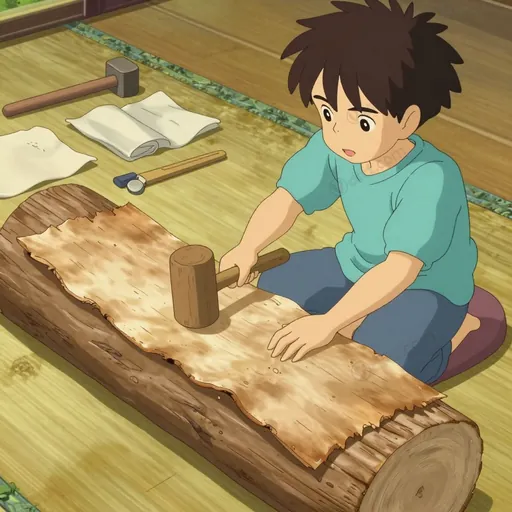
tapa bark
Noun: 1. The thin fibrous bark of the paper mulberry (Broussonetia papyrifera) and Pipturus albidus: A specific material consisting of the inner bark of these plants, known for its strength and flexibility. It is traditionally processed into a cloth-like material.
This term is used specifically to refer to the raw material—the bark itself—before or during processing. It names a substance with a distinct cultural and practical origin. - The artisans carefully harvested the tapa bark from the trees. - Traditional methods involve soaking and beating tapa bark to create cloth.
- The term is often used in anthropological, historical, and cultural contexts discussing Pacific Island societies.
- It can be part of compound nouns describing products made from it, such as "tapa cloth" or "tapa painting," but these are distinct from the bark itself.
- Tapa (noun): Often used as a shorter form, but can ambiguously refer to the bark, the beaten cloth, or the final decorated product. Context is key.
- Tapa cloth (noun): The finished textile product made by beating the bark.
- Kapa (noun): The Hawaiian word for tapa cloth.
- Paper mulberry (noun): The primary tree species () from which tapa bark is often obtained.
- Inner bark (general term)
- Bast fiber (technical term for the phloem fiber from plant bark)
The term tapa bark refers strictly to the plant material as a substance. It is the precursor to the cultural artifact known as tapa cloth. Do not confuse it with the finished cloth or decorated artworks, which have their own specific terms.
-
the thin fibrous bark of the paper mulberry and Pipturus albidus
Khám phá thêm
Các từ liên quan
Từ đồng nghĩa
Từ gần giống